
Documentary Screening & Discussion:Those Four Years by Dr Joe Thomas Karackattu
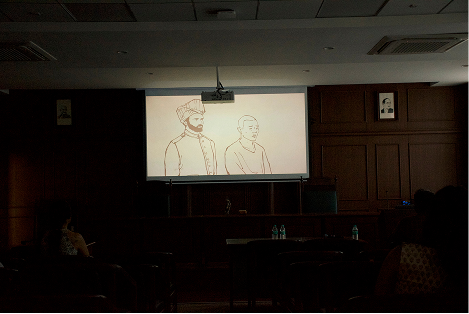
The film Those Four Years by Dr. Joe Thomas Karackattu as he explained, is set in a mid-19th century temporal context and aims to showcase the movement of people in a way that changes how we understand globalisation. In terms of spatial context, the documentary focuses on the movement of Chinese convict labour across regions such as Penang and Singapore, the Strait Settlements and into the then Madras Presidency. This movement, the film contends, complicates the prevailing binary between “the West” and “the Imperial.”
The film specifically focuses on the Nilgiris region, particularly Ooty, where it traces families who are believed to be descendants of these Chinese convict workers. It looks at tea and cinchona plantations, where Chinese labourers were brought from the Straits Settlements of Singapore and Hong Kong, as part of an experimental measure by the colonial administration, based on the perception that they were efficient workers. One of the first sites where this was implemented was the Thiashola Estate, which is now often referred to as “jail thottam” or “jail garden.”
There are also references to institutions such as the Lawrence School, which is said to have been built by Chinese convicts. Anecdotal evidence, such as the discovery of Chinese coins by students at the school, supports these claims, although the film acknowledges that there is no complete or conclusive archival proof, making these histories difficult to fully trace.
The documentary also situates this search within the broader colonial legal system at the time. A large number of Chinese prisoners were processed through an inquisitorial system that did not prioritise rehabilitation. Many were transported to the Straits Settlements and then further relocated to India. One reason for this secondary movement was the concern that convicts might integrate into local societies in places like Singapore or Penang, which the colonial authorities wanted to avoid.
A key part of the film is the director’s own journey. Dr. Joe Thomas Karackattu takes on the role of an investigator, attempting to find records and trace descendants of these convicts in Tamil Nadu. He identifies possible connections in families living along the Tamil Nadu–Kerala border, suggesting that some of these convicts may have eventually integrated into local society after completing their sentences.
The film relies on a combination of anecdotal accounts, and archival material, including shipping and judicial records from India, China, and Malaysia. Dr. Joe Thomas Karackattu stated after the screening of the film, that not all anecdotal narratives are untrue, and that they can point towards histories that have not been formally recorded. It is interesting and immensely inspiring to note that Dr. Joe Thomas Karackattu helms the roles of director, cameraman, narrator and editor, capturing his long and meticulously journalled trips with aesthetically pleasing visuals.
Overall, he said, the film seeks to contribute to a larger India–China narrative by showing historical connections between the two regions that are often overlooked. He suggested that many such stories remain untold, and that people and societies have been far more interconnected than they appear in dominant historical accounts.