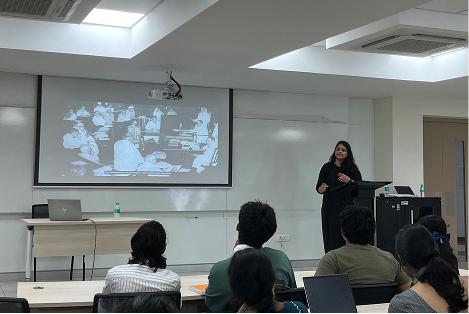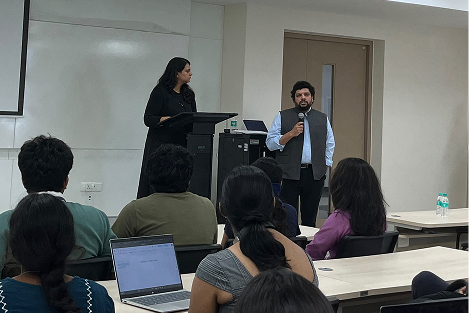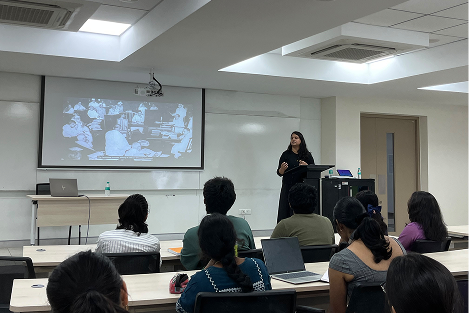

Freedom in Federalism: Suits Between the Union and States: A guest talk by Raeesa Vakil
Dr. Raeesa Vakil delivered a talk titled “The Sense of Freedom in Federalism: Suits Between the Union and States in India” She took a deliberately narrow issue, disputes between the Union and the States, and used it to ask a larger question: who should decide them?
She began with the Constituent Assembly, which debated what kind of federalism India should have and, following Ambedkar’s proposal, what role the Supreme Court should play. Making the Court the referee of federal disputes drew almost no opposition. The one dissenter was Brajeshwar Prasad of Bihar, who opposed both federalism and the Court’s role in it. She argued his broader point still deserves attention.
She then turned to Article 131, pointing out a drafting error in how it pairs “the Government of India” with “State” rather than “State Government.” The provision has barely been used: as of 2026, only 56 suits have been filed and just 21 decided. Since the Court usually reads its jurisdiction expansively, she asked why federalism is the exception, and whether that jurisdiction should be reimagined.
Next came the question of parties. Using Hobbes’s Leviathan, she separated enduring States from transient governments, and drew on Article 300 and Seervai to distinguish the Union from the government. Cases such as Rajasthan v. Union (1977), Karnataka v. Union (1977) and West Bengal’s challenge over control of the CBI showed why this matters. Public sector corporations do not survive an Article 131 suit, and agents of government and regulators complicate matters further, leaving the question: if not the State Government, then who?
She then compared the Court’s view of which disputes qualify with Seervai’s, and showed how, since 1970, the Court has limited its own jurisdiction without stating clear principles. This sits uneasily with Justice D.Y. Chandrachud’s call to strengthen federalism. Remedies have been unpredictable and enforcement weak, from Bihar v. Union (1970) through Union v. Rajasthan (1984) and Haryana v. Punjab (2002) to Tamil Nadu v. Kerala (2014). Her review of legislation cases, West Bengal v. Union (1964) and Karnataka v. Union (1977), suggested the Court has no settled idea of where a legal issue ends and a political one begins.
Finally, she asked why the Court reads its jurisdiction so narrowly and erratically. Her answer was not simply critical: avoiding politically charged disputes may be a strategic way for the Court to protect its legitimacy, not a sign of failure.
The talk was rigorous and delivered with real wit and humour, making a technical subject genuinely engaging.