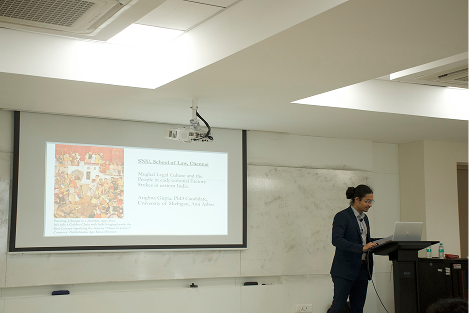
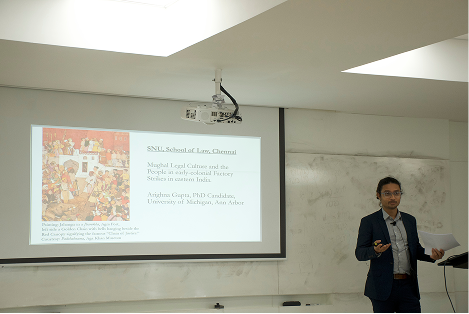
Guest Lecture by Arighna Gupta on Mughal Legal Culture and the People in Early-Colonial Factory Strikes in Eastern India
What if early factory strikes in colonial India were not acts of disorder but calculated legal strategies? In today’s lecture, Mr. Arighna Gupta rethinks early colonial resistance by showing that workers were not acting outside the law but actively using Mughal legal culture to structure their protests. In places like Bardhhaman and Arra, workers didn’t approach authority as isolated individuals filing complaints, they organised themselves as a “popular body”. Through documents like Wakalatnamas and Mukhtarnamas, they elected representatives and gave their actions a clear legal form which made it harder for the company to dismiss them as disorderly or a “public nuisance”. This also shows that resistance was not spontaneous; it was carefully organised through existing legal knowledge and practice.
The most compelling part of the lecture is the contrast between Mughal claims and British petitions. Claims were embodied and immediate, tied to presence in spaces like the Darbar, supported by oaths and embedded within networks of kinship and local authority. Petitions on the other hand, were bureaucratic and impersonal, reducing people to isolated subjects within an institutional hierarchy. This difference helps explain why workers turned to Mughal frameworks. They allowed for collective identity and negotiation rather than forcing individuals into rigid administrative roles. It also highlights how different ideas of authority shaped how people could access justice in each system
Mediation was also central to this process. Workers invoked figures like the Raja, who responded through intermediaries and documents such as Parwanas especially when Company officials repeatedly altered oral agreements. These documents became tools of protection not just communication. Overall, the lecture shows that Mughal law did not disappear under colonial rule but remained a strategic resource for organising resistance.
(This report was prepared by first-year student, Sai Harini. Photos by first-year student, Laya Balakumar)